Lead magnet ideas for creators: 8 examples that grow a list
What a lead magnet is, 8 examples for creators who sell video courses, how to choose one, how to build the opt-in page and what GDPR says about consent.
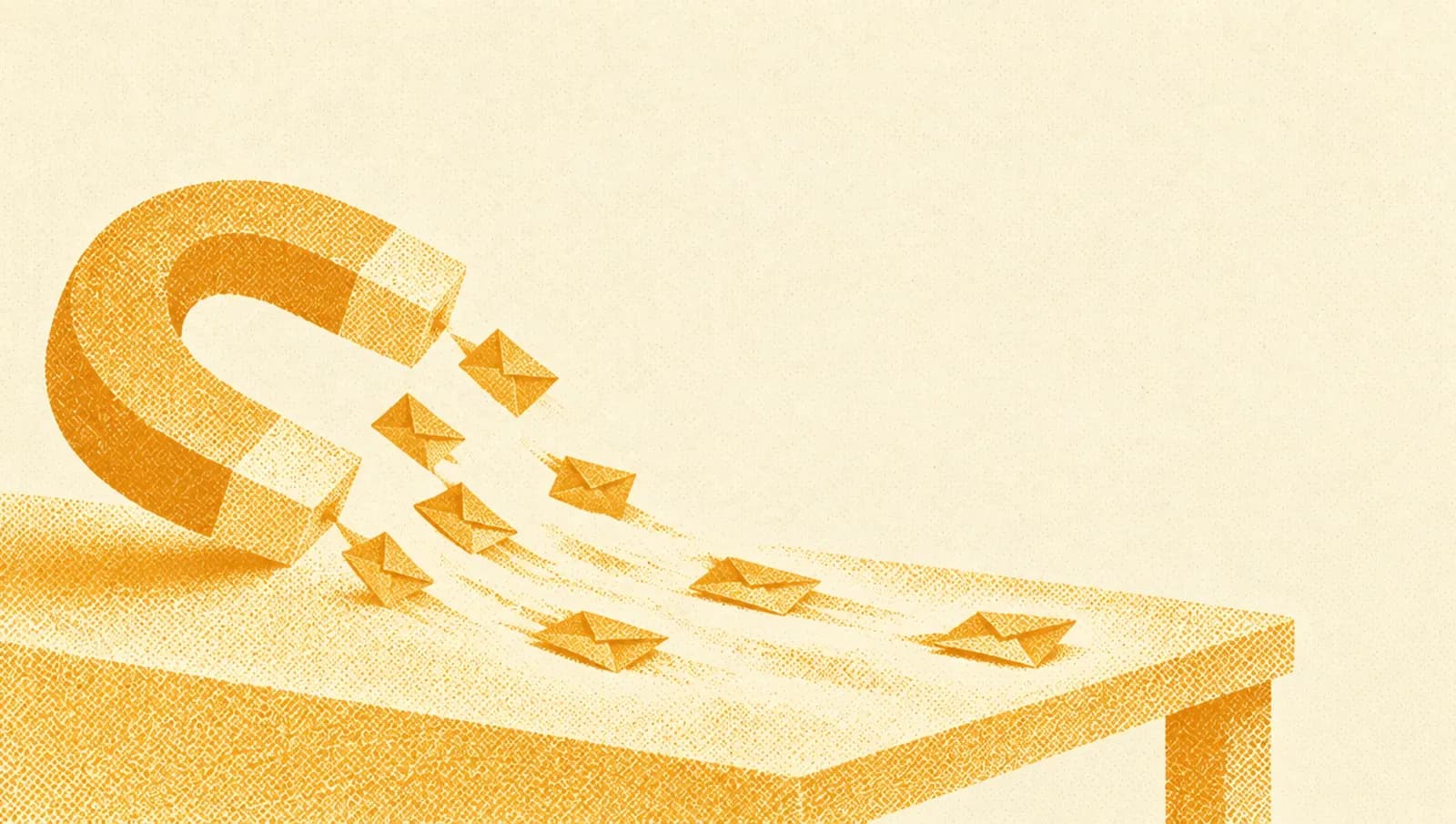
People who follow you on Instagram, YouTube or TikTok see your content when the algorithm decides. People on your email list get it when you decide. A lead magnet bridges the two: a free resource people receive by leaving an email address.
For creators who sell courses, a lead magnet has a second, often forgotten job: letting people try the way you teach. Someone who solved a small problem with your help is far more willing to pay you to solve a big one.
What is a lead magnet and what is it for?
A resource you give away in exchange for a contact, usually an email. It builds the list you will use to launch courses: without a list, every launch depends on how much reach social platforms give you that day. More in creator newsletter: your first 1,000 subscribers.
A good lead magnet has three qualities: it solves a specific problem, gives a result quickly and leads naturally to the paid course. If the course teaches YouTube editing, a good lead magnet is "12 shortcuts that halve your editing time", not "the complete guide to video".
Which lead magnets work for video course creators?
Short, practical formats that people actually use. Here are eight examples and when each works best.
| Instant result | Shows how you teach | |
|---|---|---|
| 1. One-page checklist | Yes | Partly |
| 2. Ready-to-use template or file | Yes | Partly |
| 3. A free video lesson from the course | Partly | Yes |
| 4. Five-day email mini-course | Partly | Yes |
| 5. 5-7 day challenge with tasks | Yes | Yes |
| 6. Quiz or self-assessment | Partly | Little |
| 7. Masterclass recording | Partly | Yes |
| 8. Resource or tool list | Partly | Little |
Our editorial assessment, not a study. The right format depends on your course and audience.
Checklists and templates
The quickest to make and to use. A photographer can offer a wedding gear checklist; an Excel trainer a file with ready-made formulas. They work because people use them straight away, but they show little of how you teach: pair them with an email sequence that explains the why.
Free lesson and email mini-course
A real lesson from the course (or a 10-15 minute excerpt) is the most honest proof of quality. An email mini-course, one short lesson a day for five days, has an extra benefit: it trains people to open your emails. If they open for five days, they'll open at launch.
Challenges
A 5-7 day challenge ("write one post a day", "film one video a day") gives a concrete result and creates a temporary community. It takes more work from you, but it leads very naturally into a course with live parts, as we explain in community for your online course.
Quizzes and resource lists
A quiz ("what kind of creator are you?") attracts many sign-ups but often people with little interest in the course. Link lists get downloaded and forgotten. Use them if you already have an email sequence that does the rest of the work.
How do you choose the right lead magnet?
Start from the course and work backwards: what is the first obstacle your ideal student hits? The lead magnet solves that obstacle; the course solves everything else. Three questions to decide:
- Does it solve a problem my audience asks about often? Check comments and DMs.
- Can it be used in under 20 minutes? If it takes an afternoon, most people won't finish it.
- Will users want the next step? The lead magnet opens a door; the course is the room.
If you are torn between two ideas, ask your audience with a story or a poll. It doubles as an announcement that something is coming.
An example
Picture a trainer who sells an Excel course to people working in accounts. Her students' first obstacle is wasting time on repetitive tasks, so a good lead magnet is a file with ten ready-made formulas for reconciling invoices, plus a five-minute video showing how to use them. Anyone who downloads it gets a result straight away and, at the same time, sees how she teaches. Over the following days they receive three emails: one with an eleventh formula, one with a student's story, one announcing the waitlist. By contrast, a forty-page guide to the history of Excel would attract plenty of curious sign-ups but few people ready to buy. In practice, the right lead magnet is the small, immediate version of the result the course promises, not a summary of the course.
How do you build the opt-in page?
An opt-in page has five parts: the resource title, who it is for, what's inside (three bullets), an email field and a clear note on what happens next. No menu, no links elsewhere: the page has one job.
Spell out what subscribers will get: "Get the checklist now and my newsletter every Thursday. Unsubscribe any time." It's more honest and avoids subscribers who mark your first newsletter as spam because they weren't expecting it.
What does GDPR say about email consent?
If you have subscribers in the EU, GDPR requires consent to be freely given, specific and informed, and withdrawing it must be as easy as giving it (Article 7(3)). Article 7(4) adds that, when assessing whether consent is freely given, utmost account is taken of whether providing a service is conditional on consent to processing that isn't necessary for that service.
For a lead magnet, this means automatically tying the download to a newsletter subscription is a sensitive point. We are not giving legal advice: the cautious choices are to state clearly, before sign-up, that the guide comes with the newsletter, avoid pre-ticked boxes and include an unsubscribe link in every email. Ask whoever handles your privacy compliance to review the page, especially if you sell in several countries.
People who already bought from you
Some countries have narrower rules for existing customers. In Italy, for example, the data protection authority's 2013 marketing guidelines describe the so-called "soft spam" exception: if you obtained a customer's email in the context of a sale, you may promote your own similar products without new consent, provided they were informed and do not object. It covers customers, not people who downloaded a free resource.
How do you measure whether a lead magnet works?
Track three numbers, not one: how many visitors sign up, how many open and click later emails, how many buy at launch. A lead magnet that brings many sign-ups and no sales is attracting the wrong audience.
For email, Mailchimp reports a 35.64% average open rate and a 3.02% click rate for education and training, on December 2023 data. These are vendor figures, and opens are skewed by Apple Mail Privacy Protection, so treat them as a rough guide. For other metrics, see creator metrics that matter.
See the data as a table
| Metric | Average |
|---|---|
| Open rate | 35.64% |
| Click rate | 3.02% |
| Unsubscribe rate | 0.18% |
What happens after sign-up?
Deliver the promised resource immediately, then over the next days send three or four emails that build the relationship: who you are, what you teach, one more practical tip, a story from someone who already learned with you. By launch day, these people will know who you are. We write the sequence in the email sequence to sell an online course.
Key terms. A lead magnet is a free resource offered in exchange for contact details. An opt-in page is a single-purpose page that collects that contact. Soft spam is the exception, in some EU countries, that lets you email your own customers about similar products without new consent.
How we checked. We read the text of GDPR Article 7, the Italian data protection authority's 4 July 2013 guidelines on promotional activity (section 2.7 on soft spam) and Mailchimp's benchmarks page. The table of eight formats is our own assessment: we found no independent data on lead magnet conversion rates for creators, so we don't quote one. This article is not legal advice, and rules differ outside the EU. Contact: hi@heytea.app. Editorial note: we check every figure against the sources listed below and correct mistakes openly.
Frequently asked questions
What is a lead magnet?
A free resource you offer in exchange for contact details, usually an email address: a guide, a checklist, a lesson, an email mini-course. For creators who sell video courses, it turns social followers into people you can email directly and lets them try your teaching before you ask them to buy.
Which lead magnet works best for course creators?
One that solves a small, concrete problem related to the course in under 20 minutes. Checklists and templates work because they give an instant result; a five-day email mini-course works because it trains people to open your emails. Avoid long, generic guides that nobody finishes.
Can I add lead magnet downloads to my newsletter?
Say so clearly before sign-up and make sure consent is valid where your subscribers live. Under GDPR Article 7(4), when assessing whether consent is freely given, utmost account is taken of whether a service is conditional on consent that isn't necessary for it. Many advisers recommend stating explicitly that the guide comes with the newsletter and offering an unsubscribe link in every email.
How long should a lead magnet be?
Short. A lead magnet needs to be used, not saved: if people never open it, they never meet your method. A one-page checklist, a template, a 10-15 minute video lesson or five short emails are formats people actually finish.
Do I need a website for a lead magnet?
No. Newsletter platforms provide sign-up pages and deliver the file automatically. You need one page with the resource's title, who it is for, what it contains, an email field and a clear privacy notice. Put the link in your bio, under videos and in posts.
Sources
- Regulation (EU) 2016/679 (GDPR), Article 7(3) and 7(4). Accessed 18 October 2026. gdpr-info.eu
- Garante per la protezione dei dati personali (Italian data protection authority), "Linee guida in materia di attività promozionale e contrasto allo spam", 4 July 2013, section 2.7. In Italian. Accessed 18 October 2026. garanteprivacy.it
- Mailchimp, "Email Marketing Benchmarks", data last updated December 2023. Vendor source. Accessed 18 October 2026. mailchimp.com