AI for creators: save time without losing your voice
What creators should and shouldn't delegate to AI, what to disclose on YouTube, what Article 50 of the EU AI Act says and how Italian copyright treats AI work.
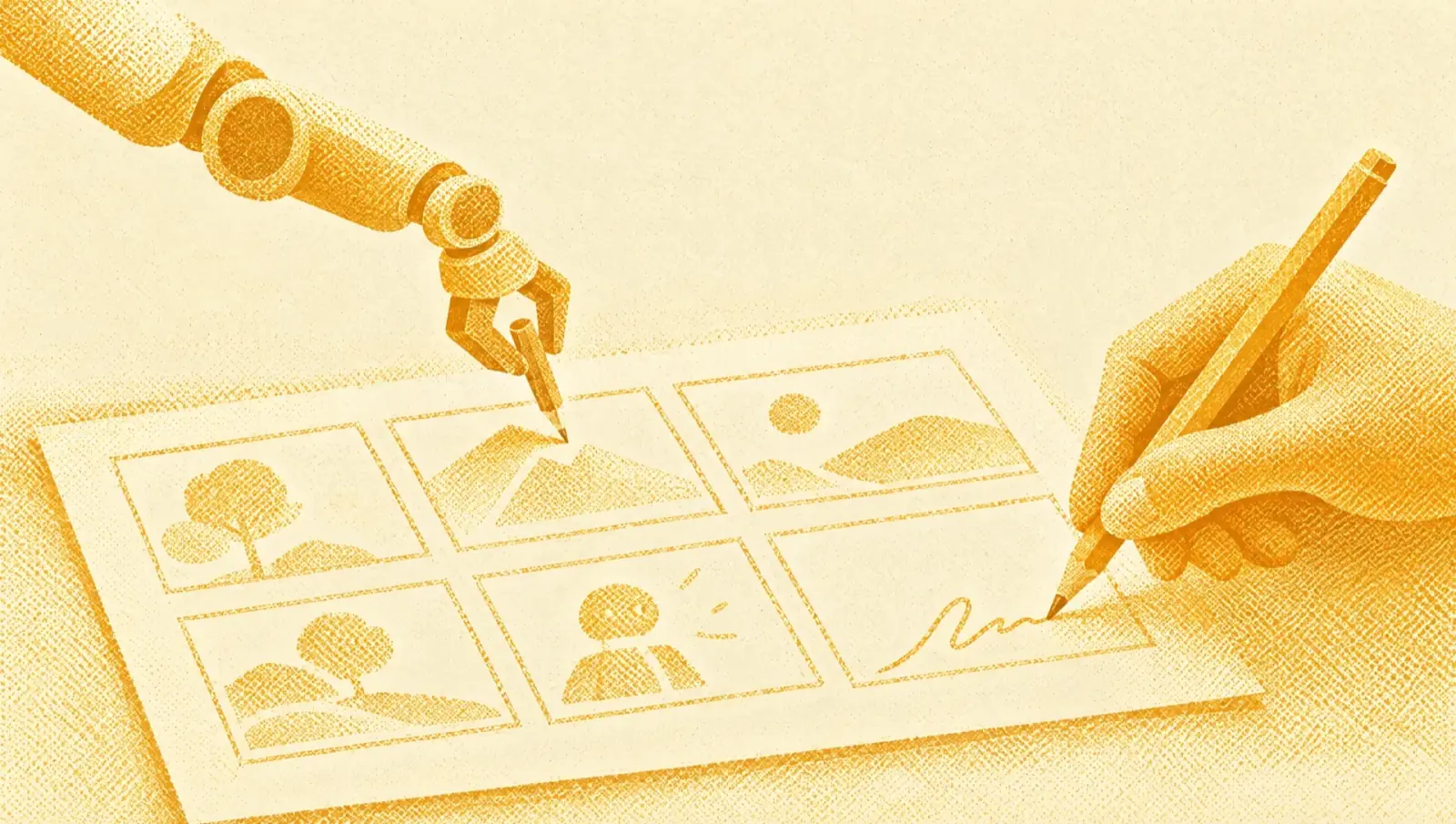
Talking about AI for creators means avoiding two mistakes: thinking it does everything, or thinking it is useless. In between is a method: work out which steps in your job are mechanical, hand them to a tool, and never delegate what people follow you for. We don't rank tools: they change every month and every list is born stale. Here we describe processes and rules.
What should you delegate to AI, and what not?
Delegate mechanical or supporting steps: transcription, captions, summaries, title ideas, first drafts, translations, audio and image clean-up. Keep for yourself your point of view, personal stories, judgement and final check. The more a step is you, the less you should delegate it.
| Delegable | You should check it | Stays yours | |
|---|---|---|---|
| Transcription and captions | Yes | Yes | No |
| Summaries and notes | Yes | Yes | No |
| Title and angle ideas | Partly | Yes | Partly |
| First draft of a script | Partly | Yes | Partly |
| Translating your content | Partly | Yes | No |
| Audio and image clean-up | Yes | Yes | No |
| Point of view and opinions | No | No | Yes |
| Personal stories and lived cases | No | No | Yes |
| Checking facts and sources | No | Yes | Yes |
A qualitative assessment by the editors, not a measurement. The right split depends on the kind of content and on how much your voice is the reason people follow you.
One limit to state plainly: a model can invent facts, sources and quotes convincingly. Every number, name or legal reference that comes out of a tool must be checked against the source, as with any collaborator.
What does a sensible four-step workflow look like?
A sensible workflow for using AI has four steps: gather and organize your own material, have a draft or structure produced, review everything with your voice and your facts, then publish with the disclosures required. The step you never skip is the human review, because that is where the content becomes yours again.
A sensible workflow has four steps: gather and organize, have a draft produced, review it in your voice, and publish with the disclosures you need. The one step you never skip is the third.
- Gather. Put together notes, transcripts and sources. The more of your own material you give the tool, the less it invents.
- Draft. Ask for a structure or a first version, not the final text.
- Review in your voice. Rewrite, cut, add a lived case. Check every fact.
- Disclose where needed and publish.
To know how much time it saves you, time a full cycle with and without the tool: we found no independent measurements, and vendors' numbers don't describe your work. If you reuse content across channels, the same logic applies to a repurposing system.
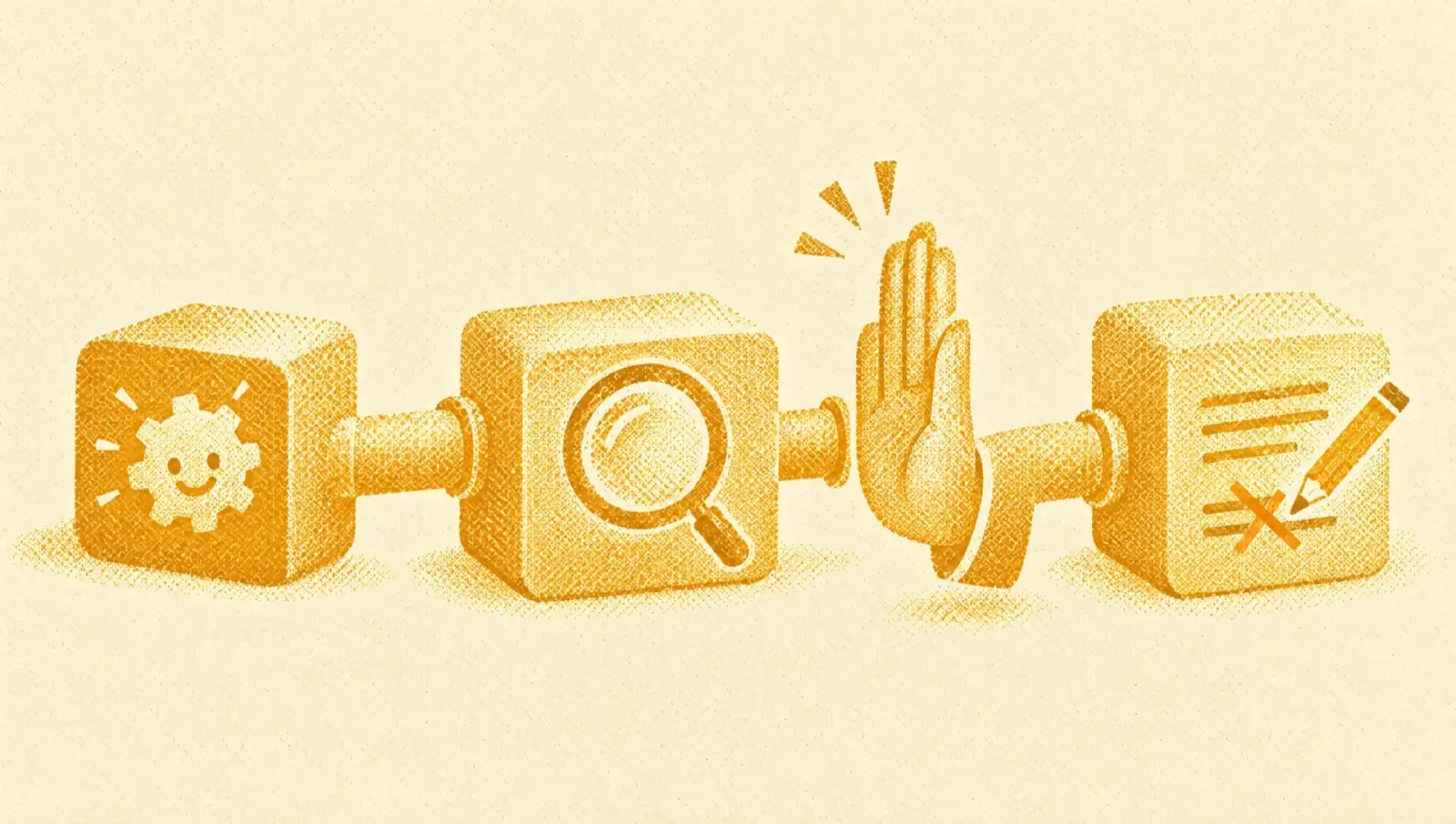
One more check is worth the time it costs: before you publish, read the piece as a reader who doesn't know you would. If a sentence could sit in any other article on the subject, it is probably the one the tool wrote in your place: replace it with a specific example, a verified number or an opinion only you can have. It is also the quickest way to catch factual errors.
What must you disclose on YouTube?
On YouTube you must disclose realistic content generated or altered with AI: a real person who seems to say or do something they didn't, altered footage of a real event or place, a realistic scene that never happened, or generated music that is the focus of the video. The setting is in YouTube Studio, under “AI use”.
| Disclose | |
|---|---|
| A real person who seems to say or do something they didn't | Yes |
| Altered footage of a real event or place | Yes |
| A realistic scene that never happened | Yes |
| Generated music that is the focus of the video | Yes |
| Scripts, outlines, titles, thumbnails, ideas | No |
| Aesthetic filters, colour, lighting, background blur | No |
| Cloning your own voice for voiceovers and dubbing | No |
| Clearly unrealistic content, like a fantasy animation | No |
A summary of YouTube's help page “Disclosing use of GenAI content”, read on 16 October 2026, with no visible update date. It does not replace the platform's text.
According to the same page, disclosure alone does not limit audience or monetization, and creators who consistently omit it risk a manual label, removal of the content or suspension from the Partner Program (YouTube Help). For Instagram, TikTok and other platforms we could not read the official pages: check their rules before you publish.
What does the EU AI Act say about labelling?
Article 50 of the EU AI Act says that anyone who publishes a deepfake, meaning generated or manipulated content that resembles existing people, objects, places or events and could pass as authentic, must disclose that it is artificial. For evidently artistic or satirical works the disclosure can be more discreet.
The text points to application from 2 August 2026 (artificialintelligenceact.eu). The site that hosts it also has a section on the simplification package (“Digital Omnibus”) that we have not read: we can't say whether it changes dates, so verify before relying on a deadline. This is information, not legal advice.
A short glossary
A deepfake, under Article 3 of the regulation, is AI-generated or manipulated content that resembles existing people, objects, places or events and would falsely appear authentic to a reasonable person. Synthetic content is text, an image, audio or video produced or altered by an AI system. A label is the indication, visible or machine-readable, that warns the audience of the artificial origin.
The practical difference: a thumbnail illustrated by AI that is plainly fantastical is not a deepfake; a video in which a real person seems to say something they did not is. For evidently artistic or satirical works the duty shrinks to flagging the existence of the content in a way that does not hamper enjoyment. When in doubt, it is safer to disclose.
Is AI-made work protected under Italian law?
In Italy the works of human creative intellect are protected, even if created with the help of AI tools, as long as they result from the author's intellectual work. This is Article 1 of law 633/1941, as amended by law 132/2025, in force since 10 October 2025. The text of Article 1 on Normattiva says it protects works of “human” creative intellect, “also where created with the aid of artificial intelligence tools, provided they are the result of the author's intellectual work” (our translation) (Normattiva). In practice, content generated with a click and published without your own creative contribution risks not being protected: keep a recognisable contribution (choices, rewriting, editing). For the rest of your rights over content and what you give up when you sign, read rights over your content.
How do you keep your voice when you use AI?
To keep your voice, write the opening and the close yourself, always add a lived case, read the text aloud and never publish a tool's first result. AI produces the average of what already exists: what makes you recognisable stays your point of view, your stories and your choices.
Your voice is the one thing AI can't give you. A few habits protect it:
- Write the opening and the close yourself. They are what people remember.
- Always add a lived case. One example of yours beats ten generic ones.
- Read it aloud. If it doesn't sound like you, rewrite it.
- Don't publish the first result. The first result is everyone's average.
- Disclose when needed. Trust is your asset, and a missing disclosure costs more than a label.
On the subject, in a January 2026 US survey 56.1% of creators thought AI would significantly change their work (Marketing Dive). It is an opinion, not a forecast. To see how this feeds into income, read how creators make money.
A last habit worth keeping: save two or three of your own best pieces as a reference of your voice, and compare every AI-assisted draft against them. If the draft reads noticeably flatter, more generic or more cautious than your reference, it needs another pass before it goes out under your name.
What does it look like in practice, from recording to publishing?
Take a twenty-minute video. You record it yourself, with your ideas and examples. Then a tool helps you at four points: it transcribes the audio, produces captions, drafts a summary for the description and suggests a few title ideas. You pick the title, correct proper names and numbers in the transcript, and rewrite the summary in your own voice. Where AI doesn't come in: deciding what to say, the opening anecdote, the final judgement. Where it comes in without trouble: captions and transcripts, as long as you reread them. The time you save lies mostly in repetitive steps, but we found no independent measurements: time your own cycle. If you then want more outputs from the same video, the method is in a repurposing system.
An example prompt and how to check the result
When you ask for a draft, give context: who your audience is, what the topic is, what should stay out. A typical instruction: “Here is the transcript of my video and the three points I want to stick. Propose a structure for a 400-word newsletter, without adding any figures that are not in the transcript.” The last sentence matters: it reduces the risk of the tool inventing things.
Then check in three passes. Compare every number and name with the transcript or the source. Cut whatever doesn't sound like you. Add a case of your own. If the draft contains quotes or sources you did not supply, treat them as unverified until you find them in the original. It is the same method we use for our own articles: if we can't read the source, we don't cite it.
Which risks should you not underestimate?
The first is the confident error: a model can cite a source that doesn't exist or a number that was never published. If a figure ends up in a video or a newsletter, check it against the original source. It is the same rule we follow when we write: if we can't read the source, we don't cite it. The second is confidentiality. Pasting a brand's contract, a client's data or someone else's emails into a tool can breach agreements and privacy rules: read the tool's terms and, when in doubt, don't. The third is contractual: some brands ask you to disclose, or not to use, AI in sponsored content, and the rights in the result depend on what you wrote in the agreement: for details see media kit and rates.
Key terms. A deepfake is AI-generated or manipulated content that resembles real people, places or events and could pass as authentic. Synthetic content is text, an image, audio or video produced or altered by an AI system. A label is a notice that tells the audience a piece has an artificial origin.
How we checked this. We found on YouTube's help page that disclosure alone does not limit audience or monetization. We found the deepfake duty in Article 50 of the EU AI Act and the human-work condition in Article 1 of law 633/1941. We found no evidence either way on AI replacing creators. Contact: hi@heytea.app. Editorial note: we fact-check every figure against the sources listed below and correct mistakes openly.
Frequently asked questions
How can a creator use AI?
A creator can use AI for support tasks: transcribing and captioning, summarizing, suggesting ideas and titles, drafting a first script, translating, cleaning up audio and images. It is less suited to what makes up your voice: the point of view, the personal stories, the final judgement. It works better as an assistant you check than as an author that publishes alone.
Do I have to disclose AI use in my content?
It depends on the platform and the use. On YouTube you must disclose realistic AI-generated or altered content, for example a real person who appears to say or do something they didn't, or a realistic scene that never happened. You don't need to for scripts, titles, thumbnails, aesthetic filters or cloning your own voice for dubbing.
What does the EU AI Act require on labelling AI content?
Article 50 of the EU AI Act says that anyone publishing deepfakes, meaning generated or manipulated content that looks authentic, must disclose that it is artificial. For evidently creative or satirical works the disclosure can be more discreet. The published text points to application from 2 August 2026: always check for postponements or amendments.
Is AI-made content protected by copyright in Italy?
Under Article 1 of Italy's law 633/1941, as amended by law 132/2025, the works of human creative intellect are protected, including when created with the help of AI tools, as long as they result from the author's intellectual work. Content generated with no human creative contribution risks not being protected.
Will AI replace creators?
We found no independent evidence either way. In a 2026 US survey 56.1% of creators thought AI would significantly change their work: that is an opinion, not a measurement. What changes is who uses the tools with a method and who doesn't, not the need for a recognisable voice.
Sources
- YouTube Help, “Disclosing use of GenAI content”. Page with no visible update date. support.google.com
- Regulation (EU) 2024/1689 on artificial intelligence, Article 50 (transparency obligations), text read on artificialintelligenceact.eu. artificialintelligenceact.eu
- Normattiva, Italian law of 22 April 1941 no. 633, Art. 1 as amended by law 132/2025 (text updated to 12 June 2026). normattiva.it
- The Influencer Marketing Factory, press release on Marketing Dive, 24 February 2026. An agency source, self-reported data. marketingdive.com