Per-student watermarks for video courses: how they work
What a per-student video watermark is and what you can read in a leaked copy in 4 cases. Visible vs forensic: limits and privacy, with no hype or promises.
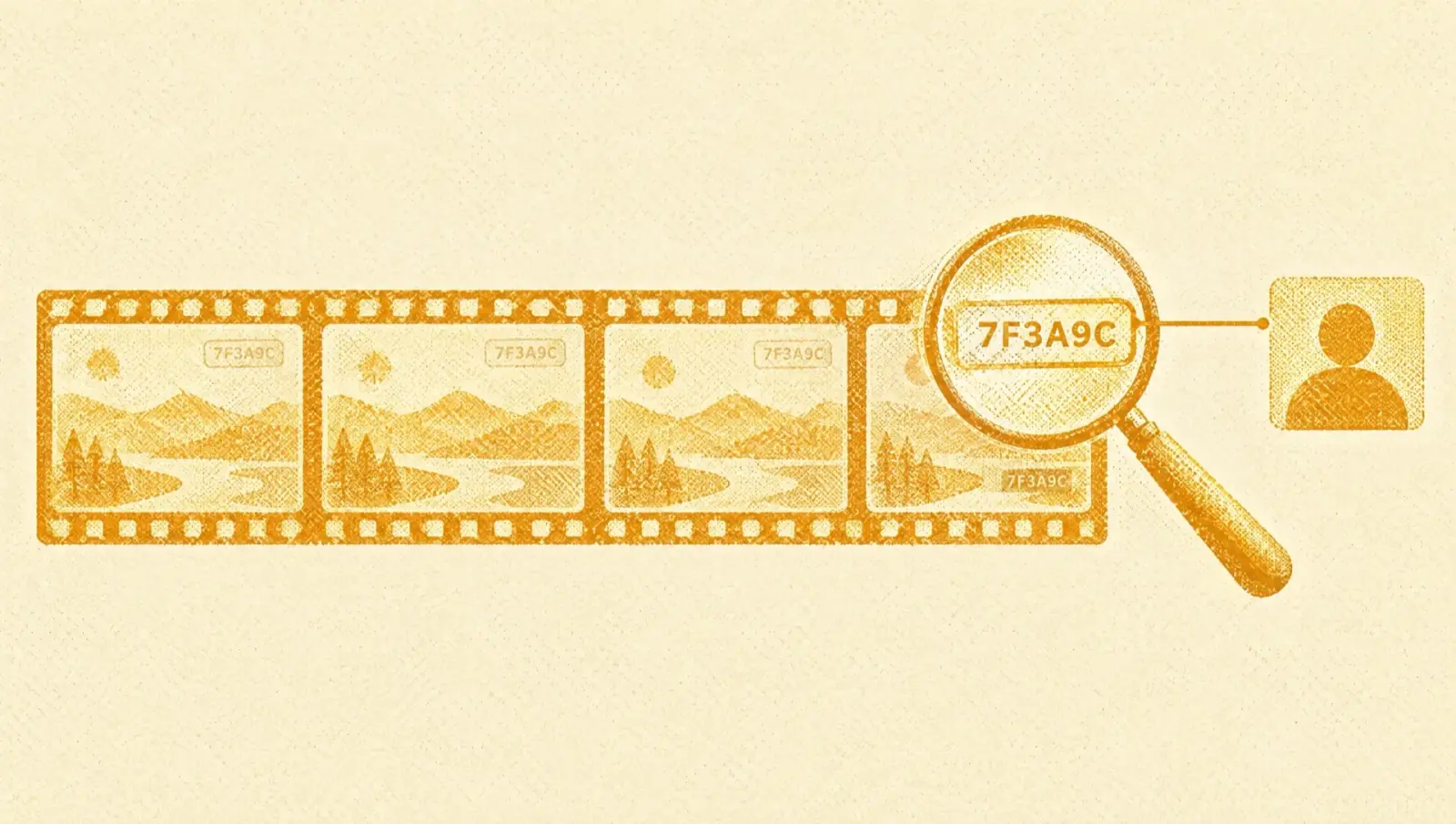
One clarification first. If you were looking for a way to put your logo on your videos, that is not what this is about, and plenty of free tools do it. This article is about the personal code that links a copy of a lesson to the account it was recorded from.
The scenario is simple. A lesson from a course you sell for $500 ends up in a channel with thousands of members. You know it is yours, but you don't know where it leaked from. With a per-student watermark, sometimes you do.
What is a per-student watermark?
A per-student watermark is a personal code tied to the viewer's account that appears on the video during playback. It links a leaked copy to the account it was recorded from. It does not prevent copying: it makes a copy less anonymous. The name matters. "Per student" means every enrolled person sees a different code, not the same one across the whole course. A logo that is identical on every video only says whose course it is. A different code for each account also says who was watching. The code does not have to be a name or an email. More often it is a short string that means nothing by itself, and an internal record links it to an account. If the lesson ends up online and the code is still visible, you look it up in the record and find the originating account. For the comparison with DRM and device limits, see our guide to video course piracy: here we go deep on the watermark alone.
Visible or forensic watermark: what is the difference?
A visible watermark is an overlay anyone can see. A forensic watermark is invisible and embedded in the video. The first deters, the second identifies the source; the visible one is cheap, while forensic marking needs detection tools and usually a specialist vendor. Almost all the sources we found come from vendors, so read them with care. Verimatrix, which sells video protection, describes the visible watermark as a cheap deterrent that someone copying can crop, blur or cover, and the forensic one as a mark in the video that survives re-encoding and format changes (Verimatrix). Kinescope, which targets courses, writes that forensic marking identifies the source after a leak but doesn't prevent it, and that invisible marks need enough footage to be read (Kinescope).
Kinescope also says that in the course world a visible per-viewer overlay is used more often than a cinema-grade invisible mark. That is a vendor's statement with no independent source, so we report it as such, not as a fact.
One thing none of these pages says clearly: in the sources we found there are no independent studies measuring how many leaks watermarks prevent. Anyone quoting a percentage is taking it from their own marketing.
What can you actually read in a leaked copy?
It depends on how the copy was made. If the lesson was recorded in full and the code stayed on the video, you can read it. If it was cropped, blurred or covered, a visible watermark is lost. With a recording made by another camera, it may or may not stay legible.
Quality matters most for reading: a small code in a compressed video filmed by hand can become illegible. Here is a qualitative comparison, with no figures, of the two types in the four most common cases.
| Visible watermark | Forensic watermark | |
|---|---|---|
| Full copy of the recording | Readable | Readable |
| Video cropped to remove the code | Lost | Sometimes |
| Code blurred or covered in an edit | Lost | Sometimes |
| Screen filmed with another camera | Sometimes | Sometimes |
A qualitative comparison, not a measurement. For the forensic watermark the column reports what vendors claim, because we found no independent tests. “Sometimes” means it depends on the quality of the copy, the length of the footage and the detection tool.
There is a limit that applies to both. A watermark identifies an account, not a person. If the student lent their credentials, or someone took them, the code leads to the student and not to whoever recorded. That is why we treat the result as a clue to check, not an accusation: look at the recorded access, devices and times first, then talk to the account holder.
How you look a code up, step by step
When you find a copy with a legible code, the process is simple and should be followed methodically. First keep the copy exactly as it is, without recompressing it: every conversion step makes it less legible. Then read the code carefully, even frame by frame, because similar characters (0 and O, 1 and I) are easy to confuse.
With the code in hand you look it up in the platform's records, which link it to an account and its sessions: date, time, device, duration. In Tea this is the code search in the creator's workspace. At that point you have a clue, not proof: check whether the sessions fit the copy (the lesson recorded, the time), whether the account had access from unusual devices and whether there was simultaneous viewing. Only then do you talk to the account holder, without accusing them: they may have lent their credentials or lost them.
If the copy is already public, a report to the platform can start straight away, even without knowing who uploaded it: we explain it in the first-48-hours checklist.
Can a watermark be removed?
A visible watermark can be removed with an edit: crop the frame, blur the corner or cover the code. It takes time and an editor, but it is within reach of anyone who really wants to. That is why a visible overlay works mostly as a deterrent, not a barrier. It happens elsewhere too. In the sources we read, the most cited case is awards-season screeners, where the individual mark traced copies back to a single source (Digimarc). The account comes from a company that sells watermarking and covers a case from long ago: it explains the principle, not how well any specific system works, least of all ours. There is also the opposite anecdote of a copy that circulated after someone blurred the visible mark, but we have not verified it against a primary source, so we don't use it as an example.
A forensic watermark resists crops and edits better, at least according to those who sell it. Here the point is honesty: anyone who promises it as foolproof is claiming something nobody has shown independently. Even that type of mark has limits that the vendors themselves state: you need enough footage to read it and it should not be re-encoded before analysis.
How does the Tea watermark work?
The Tea watermark is a visible overlay drawn by the player on top of the video, with a personal code per student that moves around and a diffuse pattern. During playback the player checks that it has not been removed, hidden or made transparent, and it logs the attempt. It is not an invisible forensic watermark.

We say it precisely because it is easy to imply otherwise. The player's check applies while the student is watching in the browser: if someone records the lesson with software and then edits the file at home, the player doesn't see it and can't stop it. What remains is the copy with the code, if it is legible, and the session log: when, from which device, for how long.
Alongside the watermark, Tea limits each account to two devices and flags simultaneous viewing without blocking it: we preferred to gather data before shutting out someone who has paid. An invisible forensic watermark is a development we are considering, not something we offer today.
To choose where to sell your course, our platform comparison shows what the price lists state. If you want to see how it looks, we are selecting a few creators for the Pilot, and there is a demo lesson in the player.
Privacy: can you show a student code?
A code that does not reveal a name or email is more cautious than clear data, but it remains an identifier linked to a person, and therefore personal data. That is why students should be told beforehand: what is shown, for what purpose and how long records are kept. This section is informational, not legal advice, and the exact picture depends on your case. If you sell to people in the EU or UK, data protection law (GDPR) requires you to inform the people whose data you process. For a video course that means stating, for example in the privacy notice and the terms, that a personal code appears during viewing, that it serves to protect the content and to trace any unauthorized distribution, and that access is logged. Have a privacy professional advise you before you publish those sentences.
Two choices help and cost nothing. Show a code that says nothing on its own, instead of a name or email. And keep records only as long as the purpose you declared requires.
How do you introduce it without losing students' trust?
The simplest way to avoid friction is to say it up front. Someone who buys a course and later discovers the videos carry a personal code can feel watched. Someone who knows in advance, from one honest sentence, usually doesn't mind.
- Write it on the sales page. One line is enough: “Every lesson shows a personal code that helps protect the work of the people who made it.”
- Explain the purpose. It is not surveillance: it exists to find the origin of a copy, if it ever happens.
- Don't accuse on the code alone. If a code shows up in a copy, start from the recorded access and devices, then ask questions. An account can be lent or compromised.
- Put the rule in the terms. Sharing credentials or redistributing lessons must be forbidden in writing. The rights and clauses to write down are in Creator content rights.
If you are already in the situation where your course is out there, start with a checklist and a report template for Telegram. The watermark helps you find where a copy started, not make it disappear.
Key terms. A per-student watermark is a personal code tied to a viewer's account and shown on the video. A forensic watermark is an invisible mark embedded in the video itself. A visible watermark is an overlay anyone can see, which deters but can be covered.
How we checked this. We found in the code of Tea's player that the overlay check runs only during playback in the browser. We found no independent study of how many leaks watermarks prevent. We found the Kinescope and Verimatrix pages useful for concepts but not for numbers. Contact: hi@heytea.app. Editorial note: we fact-check every figure against the sources listed below and correct mistakes openly.
Frequently asked questions
What is a per-student watermark on a video course?
A per-student watermark is a personal code tied to the viewer's account that appears on the video while it plays. It is not a logo: its job is to link a leaked copy to the account it was recorded from. It does not stop anyone from filming the screen, but it deters people from doing so and, if the code stays readable, points to an account.
What is the difference between a visible and a forensic watermark?
A visible watermark is an overlay you can see, so it deters, but someone can try to crop or cover it. A forensic watermark is invisible and embedded in the video itself, and it helps identify the source even when there is nothing to read. The second needs specific detection tools, usually from a specialist vendor, and costs more.
Can a video watermark be removed?
A visible watermark can be cropped, blurred or covered in an edit, especially by someone willing to put in the work. A forensic one holds up better, but the vendors who claim so publish no independent tests. No watermark should be presented as foolproof: it is a deterrent and a trail, not a guarantee.
Does a watermark stop course piracy?
No. A watermark does not prevent copying a lesson, and no technology prevents someone from filming a screen with another camera. It works first on behaviour, because people who know they can be identified think twice, and afterwards as a trail. What it gives you is a clue about an account, not proof of who the person was.
Is showing a student code legal under privacy law?
A code that does not reveal a name or email is more cautious than showing personal data in clear, but it is still an identifier linked to a person. That is why students should be told in advance what is shown, why, and how long records are kept. This is information, not legal advice: have a privacy professional check your wording.
Sources
- Verimatrix, “Visible vs. Forensic Watermarking: What's the Difference?”. A vendor source, with no data. verimatrix.com
- Kinescope, “Forensic watermarking: trace a course leak to one account”, 13 August 2026. A vendor source; used for concepts, not figures. kinescope.com
- Digimarc, press release on the Academy screeners case. A vendor source and an old case. digimarc.com
- For the comparison with DRM and the device limit, and for sources on piracy, see our guide to video course piracy.